

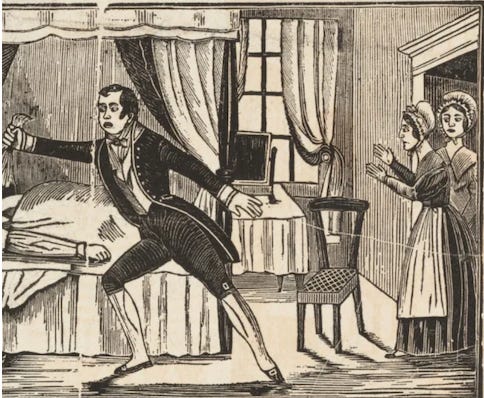
As my founding members will know, I’ve been researching some early historical homicides to look for evidence of prototype detective skills, and I’ve been particularly fascinated by the investigation into the murder of Lord William Russell, former member of parliament and brother of the late 5th Duke of Bedford, who was killed while asleep in his bed at home on Mayfair in 1840.
This was one of the most shocking and sensational murders of the early nineteenth century, and it features some brilliant detective work, even though there were no ‘formal’ detective officers in the Metropolitan police force at the time. Not only does this historic investigation showcase the sleuthing skills of individuals, such as Inspector Nicholas Pearce, it reveals how this event paved the way for the establishment of the élite detective department at Scotland Yard, just two years later. It also captured the imagination of Charles Dickens.
On 6 May 1840, housemaid Sarah Mancer woke up at 6.30 am and got ready for her daily duties at the home of Lord William Russell, at 14 Norfolk Street (now Dunraven Street), behind Park Lane, Mayfair, near to Marble Arch. Before she went down the stairs to the kitchen, she knocked on the bedroom door of the valet, François Courvoisier, as she usually did every morning. Getting no answer, she carried on but then stopped abruptly as she noticed that the warming pan, which had been left on the landing next to her employer’s bedroom had not been moved. This was unusual.
Mancer went down to the drawing room and noticed that Lord William’s writing desk had been turned round. Four drawers were open, and his keys and several of his papers were lying on the hearth rug. There was also a screwdriver on his chair. Alarmed about the robbery, the maid ran back to the valet’s room and woke him up. She followed Courvoisier into Lord William’s room, where they found their master lying on his four-poster bed, the covers of which were soaked in blood. His throat had been cut.
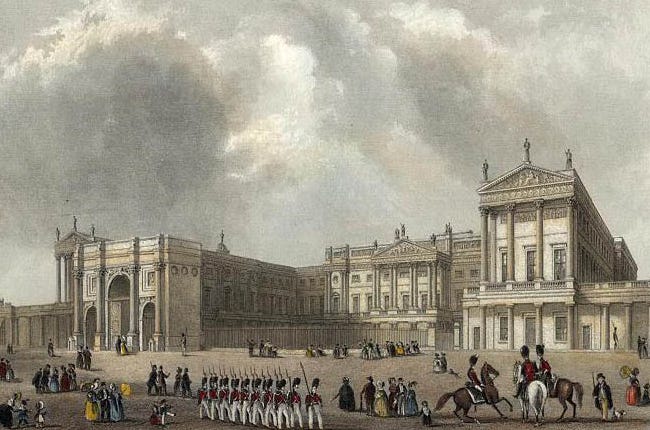
As soon as they learned of Lord William’s violent death, the two footmen rushed out to call the police. The first officers on the scene were Constables John Baldwin and William Rose. They were swiftly followed by Inspector John Tedman of C Division (St James’s, Westminster). After speaking to the hysterical servants, he went upstairs to view the body. He later described what he saw:
I pulled the napkin off [which covered Lord William’s face], turned the clothes down, and saw a great quantity of blood in the bed, from his lordship’s head down to the middle – the blood was in the bed, and on one pillow, there was some blood, but not much…he looked as if he was asleep – his eyes were closed, and the tongue protruded a little way out.
Tedman immediately called for a doctor, who declared that the victim had been dead for three to four hours. Lord William had a large gash to the throat, which was five inches deep and seven inches long. Death would have been instantaneous.
The police wasted no time in investigating this brutal murder. Inspector Tedman began by examining the crime scene, and he discovered that Lord William’s watch, some cash, jewellery and other valuables were missing. However, when Tedman checked downstairs, he found some more valuable items had been left in the passageway which seemed odd to him. ‘No thief would ever leave this property behind,’ he later testified.
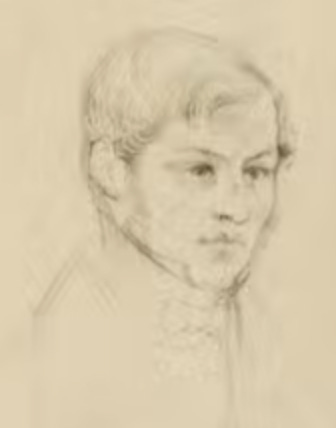
With the assistance of the valet and the two constables, Tedman then inspected the back door, through which the intruder had apparently gained entry to the house. There were definite signs of forced entry but something was not quite right. By this time Inspector Henry Beresford had joined him. He took statements from the staff and searched their belongings – he found a chisel in Courvoisier’s room which would be an important piece of evidence. When Beresford compared it with the marks on the back door, he found that it was a match. This was an inside job. But they had nothing to link the valet to the crime.
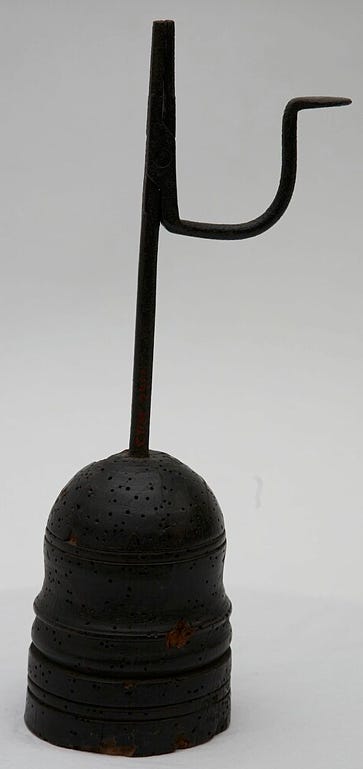
Inspector Beresford also conducted some interesting experiments. Lord William’s nightly habit was to leave a rushlight – a candle made from soaked rushes in fat – burning when he fell asleep. However, on the fatal night, the candle had not burned out. As a third of the candle had only been used, the police deduced that Lord William had been murdered about an hour and a half after he had retired to bed, after which his attacker had snuffed out the light. When the officers questioned the valet about this, he said that Lord William must have been reading in bed and extinguished it before he went to sleep. However, the other servants told them that their employer never read in bed. This was very suspicious indeed, but there was still no evidence that Courvoisier was the killer.
While the investigation was taking place, another senior officer arrived at 14 Norfolk Street. Inspector Nicholas Pearce was from A Division (Whitehall). He also examined the back door and, with the help of a carpenter, he concluded that the door had not been closed, and the marks had been made later to make it look like there had been a burglary. Pearce even cut out sections of the door frame, which he would use later in court to demonstrate his theory. He also uncovered the crucial evidence that would solve the case.
While Inspector Pearce was examining the rest of the house, he spotted that the skirting board in the valet’s pantry was loose. He ripped it away from the wall and discovered the items stolen from Lord William: five gold rings, some gold coins in a purse, a bank note, and a medal from Waterloo. Pearce also located the missing watch and a locket in other parts of the house. When he confronted Courvoisier with this new evidence, he denied all knowledge of them.
Despite his denial, François Courvoisier was arrested and charged with the murder of Lord William Russell. He was tried at the Old Bailey on 18 June 1840. The court case lasted two days, and Courvoisier was found guilty and sentenced to death.
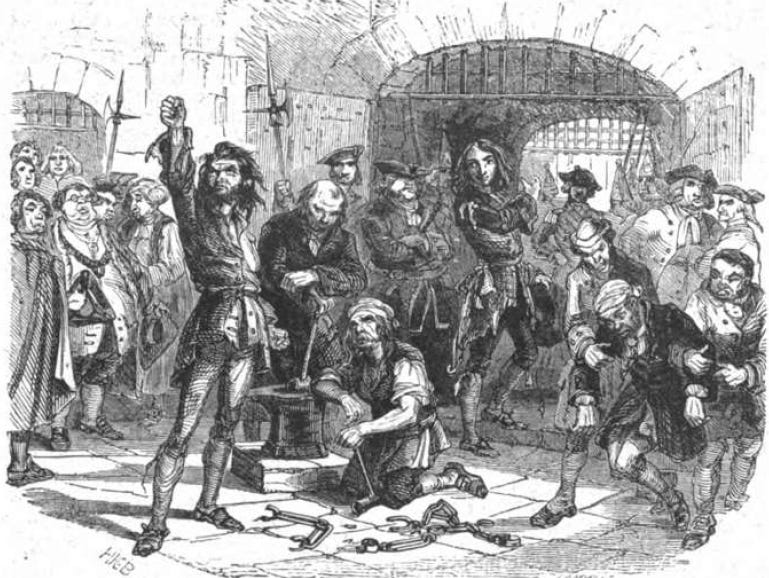
On Monday 6 July, François Courvoisier, who originated from Switzerland, was hanged at Newgate Prison. Among the vast crowd of forty thousand spectators, was Charles Dickens who had decided, against his better judgement, to watch the ‘loathsome spectacle’. He used his experience to create the execution of the ostler, Hugh, and Ned Dennis, the Tyburn hangman, in Barnaby Rudge, which was serialised the following year:
All was brightness and promise, excepting in the street below, into which (for it yet lay in shadow) the eye looked down as into a dark trench, where, in the midst of so much life, and hope, and renewal of existence, stood the terrible instrument of death. It seemed as if the very sun forbore to look upon it.
But it was better, grim and sombre in the shade, than when, the day being more advanced, it stood confessed in the full glare and glory of the sun, with its black paint blistering, and its nooses dangling in the light like loathsome garlands.
The case of the murder of Lord William Russell caused panic within the upper middle classes and highlighted the ineffectiveness of a preventative police force. It was instrumental in the establishment of the detective department at Scotland Yard in 1842.
Love reading these Detective Notebooks. This one especially drew my attention as it was set in Mayfair. I can imagine my own ancestors reading about this crime in the Newspapers and feeling very uneasy. They lived in streets not far from the scene of this crime and would certainly have known of the victim.
What a fantastic read! Really glad this came across my feed. 🤓