
'Getting the boat'
A brief history of penal transportation

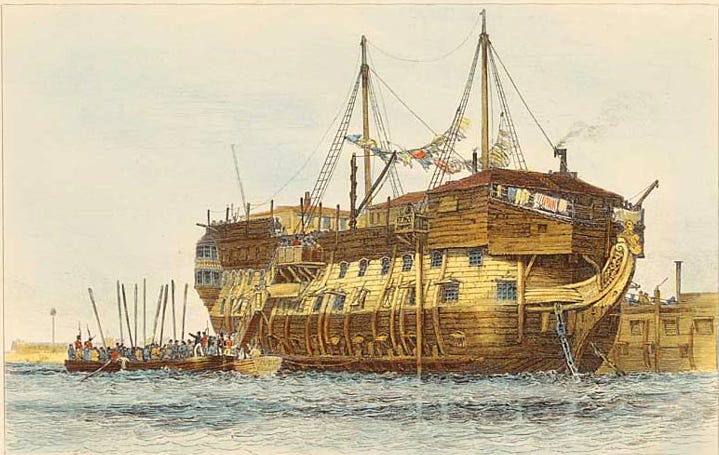
Earlier this year I gave three lectures on historical crime and punishment for an online course hosted by the Society of Genealogists. I briefly touched on penal transportation, as this sanction sometimes features in family history research. I’d like to share with you my investigation into this rather draconian and often grim form of judicial punishment in more detail here, as it has a compelling history.
In nineteenth-century slang, if you were ‘getting the boat’ or had been ‘lagged’, it meant you’d been sentenced to transportation to a penal colony overseas where you would usually remain for seven or fourteen years, and maybe even for life. It was a harsh sentence which may have begun with a disease-ridden stay on a prison hulk, a long and arduous sea journey and then arrival in a completely unknown country, where you had to be tough to survive. It’s a fascinating topic, especially if you find that you have an ancestor in your family tree who was transported.
An early history
From the early 1600s to the late 1800s, transportation was used as a means of punishment in Great Britain. Convicts were shipped from the British Isles to many far-off locations, including the West Indies, America, Australia and Tasmania. Originally transportation was used as an alternative to the death sentence, so an individual could escape the noose by crossing the ocean to settle in an overseas penal colony such as, in the late eighteenth century, when some 160,000 convicts were transported to Australia. Wherever they went, transportees would have experienced hardship and deprivation in the notorious prison hulks while they awaited transportation, on the perilous journey across the sea and under the harsh régime of a penal colony on the other side of the world.
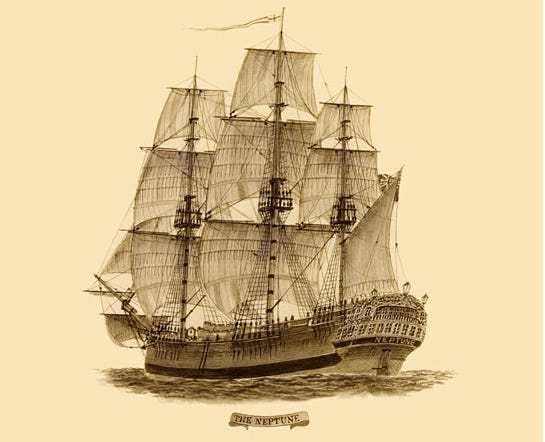
The transportation of criminals from the British Isles was first authorised in 1597, through the Vagabonds Act, which authorised the banishment of ‘dangerous’ criminals to overseas colonies, as an alternative to the death penalty. In 1615, a Privy Council Order permitted the extradition of convicts to America. Convicts under sentence of death could be sent to penal colonies in the West Indies and North America, such as Virginia and Maryland. The government paid private merchants to convey the convicts across the Atlantic. This marked the official beginning of penal transportation.
After the Transportation Act 1717, British courts could give sentences of transportation for non-capital offences. Convicts continued to be sent to America until the War of Independence, in 1775, after which it was no longer possible. Transportation to North America was followed by experiments to establish penal colonies in parts of western and southern Africa but these attempts failed due to the challenging climatic conditions, and the government was forced to house prisoners back on the British mainland.
Towards the end of the eighteenth century, British prisons became so overcrowded that the government reintroduced the practice of transportation. On 13 May 1787, the First Fleet of Convicts set sail for Botany Bay in New South Wales on the eastern coast of Australia, with more than 1,500 people on board, including some 550 male convicts and 200 females (the remaining passengers were ‘free’ individuals). They arrived in Sydney Cove in January 1788 and formally declared New South Wales a British colony. Transportation to New South Wales continued until 1840, after which convicts were shipped to Western Australia. In addition, over 67,000 prisoners were transported to Tasmania, then known as Van Diemen’s Land. Convicts were also sent to Bermuda and Gibraltar.
Banishment as punishment
From the mid-eighteenth century, transportation was meted out as a punishment for a wide range of crimes. Some were serious offences, such as arson, highway robbery and murder, whilst others seem quite minor now, such as theft and poaching. If an individual had previous convictions, they were more likely to be transported. In Nottinghamshire, between 1784 and 1867, most of those sentenced to transportation were convicted of theft, such as clothing, food, household items, and even ribbons. Other Nottinghamshire crimes were burglary, the murder of an illegitimate child and bank robbery. One sobering example is the case of thirteen-year-old Joseph Peverill, who was sent to Van Diemen’s Land for stealing four boxes of matches.
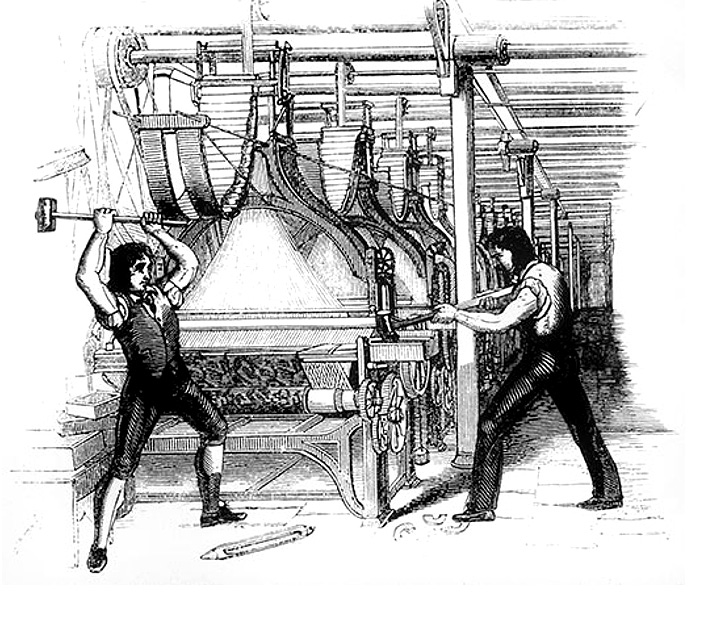
Outbreaks of rioting were also punished by transportation, as a deterrent to others. Following the Swing Riots in 1830-1831, nineteen prisoners were executed, 600 imprisoned and some 500 transported. The Tolpuddle Martyrs, who led trade union action in Dorset in 1834, were all transported to Australia.
Sentences for transportation ranged from five years to life. For those convicted of capital offences, conditional pardons replaced the death penalty with fourteen years’ transportation. For non-capital crimes, seven years was the norm, with fourteen for habitual offenders. There were no limits on gender or age, and many children were transported, sometimes as young as nine years old. Also, women were more likely to be transported than men for lesser crimes, in order to redress the shortage of women in the colonies. These women were particularly vulnerable and often subjected to abuse by male prisoners and crew members.
Floating prisons
From 1776, many of those sentenced to transportation were sent to prison hulks to await their journey overseas. The prison hulks were decommissioned derelict wooden ships moored in the Thames estuary and on the south coast of England, at Chatham, Sheerness, Portsmouth and Plymouth. They were also used as holding prisons for other convicts, as well as temporary prisons during periods of overcrowding. The first convicts were received on board the prison hulk Justicia in 1776. In 1798, it was estimated that between 1,400 and 1,900 convicts were confined in hulks.
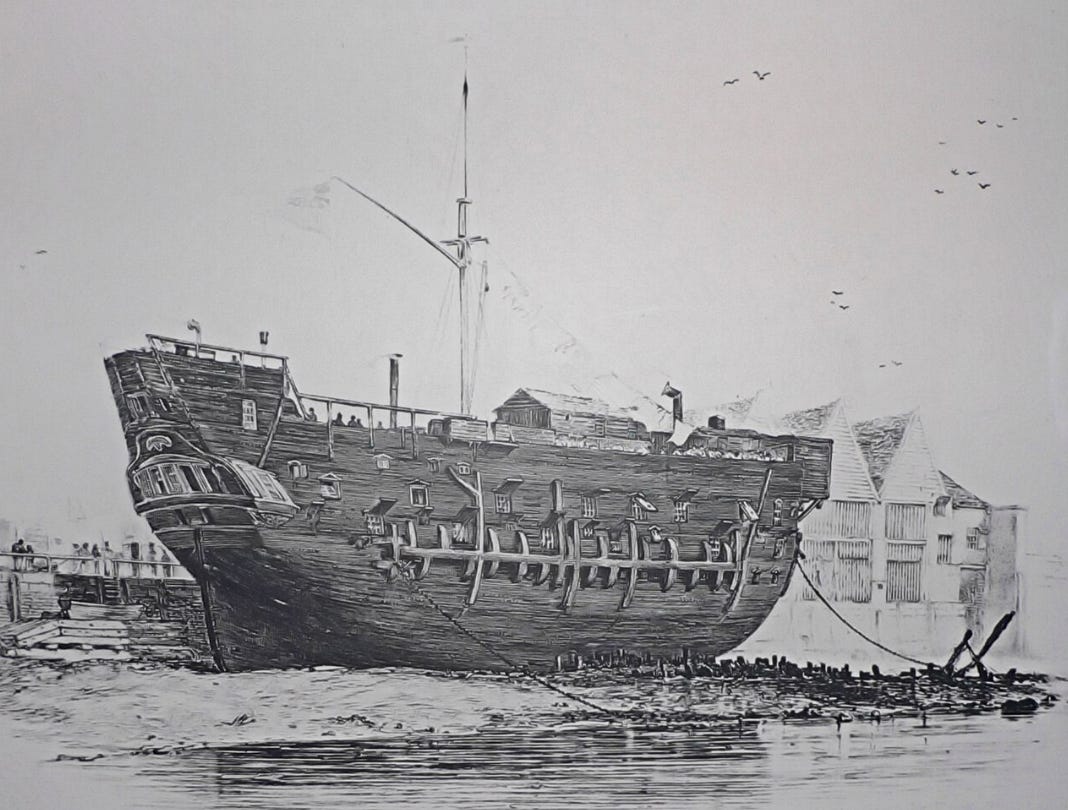
Prisoners endured terrible conditions on the hulks with as many as 500 convicts housed on each hulk, in cramped spaces with meagre food rations and minimal sanitation. They suffered from cold and damp, and had to undertake hard labour, such as dredging the river Thames. Disease was rife and the death toll was high.
The end of transportation
From the early 1800s, the practice of sending convicted criminals overseas began to decline, due to political changes in the colonies and the increasing expense of sending prisoners such long distances. From 1837, it became more common for prisoners with shorter sentences to serve their time in prison.
In 1853, the Penal Servitude Act replaced transportation for lesser crimes, with imprisonment with hard labour. It also introduced the ‘ticket-of-leave’ system, whereby prisoners could be released on licence under police supervision. Transportation was abolished completely in 1857 and gradually phased out. The final convict ship set sail for Western Australia in 1867, bringing the overall total of women and men sent there to about 162,000.
Finding convict ancestors
Convicts receiving transportation sentences were tried at the local quarter sessions and the county assizes, including the Old Bailey. County record offices hold the quarter sessions records, with accompanying documentation, such as transportation bonds. Assize court records are available at the National Archives (TNA), in the series ASSI (1559-1971). Old Bailey trial transcripts can be accessed for free via oldbaileyonline.org.
Once you know that your ancestor was sentenced to transportation, the next step is to find out the name of their ship and the date on which they sailed.
There are many different kinds of transportation-related registers and documents held at the National Archives and, if you’re interested in investigating further, it’s best to start with one of their excellent research guides, such as Criminal Transportation.
There are also many websites which feature or are dedicated to transportation. Here are a few:
The Digital Panopticon – traces the lives of 90,000 convicts sentenced at the Old Bailey, including transportation to Australia, from 1780-1925.
Convict Records – the stories and data of some 150,000 individuals transported to Australia from 1787 to 1867.
First Fleet Online – information about the convicts transported to Australia in 1787.
Prison hulks on Thames – TNA podcast introduction to prison hulks.
The National Library of Australia – research guide and introduction to records on the transportation and arrival of convicts.
Libraries Tasmania – introduction to transportation to Tasmania (Van Diemen’s Land) and online names search facility.
If you find an ancestor who was transported to the penal colonies, I’d love to hear about them and how they fared.
(Feature image – Convicts boarding a prison hulk in Portsmouth, Edward William Cooke, 1828)
In The Confidential Files later this week, I’ll be turning my attention to the use of crime scene maps and sketches by Victorian and Edwardian police detectives, including new insights on these prosecutorial aids from my doctoral work.
And, next time in The Detective’s Notebook, I’ll be investigating the rather quirky history of phrenology, so prepare to have your head examined (sorry!)
Great read - thorough and educational. Loved it