
Death by antimony
An everyday Victorian murder weapon?

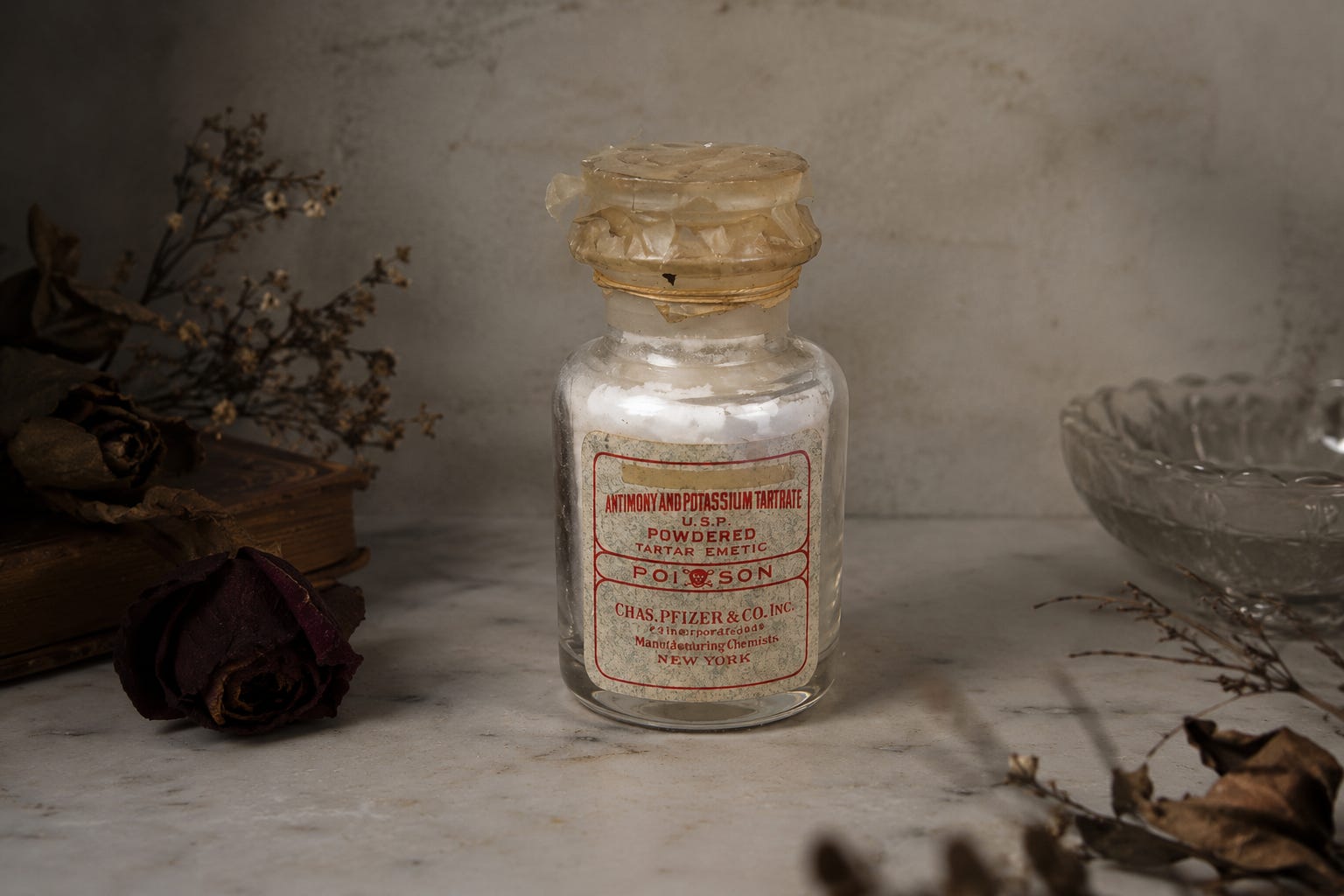
One of the more intriguing features of the Charles Bravo case is that he died from antimony poisoning. The doctors, including Sir William Gull, had initially assumed he had ingested arsenic, but during the first inquest into his death, Professor Theophilus Redwood – who had analysed samples from Charles's body – revealed that the toxin was in fact antimony. There is a wonderful moment in the second inquest when the professor produced a vial of diluted antimony in the courtroom and invited the jurors to taste it. They did.
Whilst researching the characteristics and properties of antimony, I came across several other real-life historical homicides in which this poison played a deadly role – including one of the most famous Victorian crime cases, that of William Palmer, the Rugeley Poisoner, some of whose victims’ bodies contained traces of both antimony and strychnine. In another, far less well-known case, the poison was administered in a cake laced with fish hooks, which the investigating detective later fashioned into some rather macabre souvenirs.
Antimony, it seems, has a particular association with the more bizarre and sensational murders of the past. Here are three cases I have been investigating alongside my research into the Bravo affair – together with the full story of that extraordinary moment when the jurors tasted antimony in the inquest courtroom.
